

Uber Part III: Delivery
Uber's Hidden Growth Engine: How Delivery Is Becoming a $100 Billion Business
Disclaimer. Please read full disclaimer at the end of the page before reading the article. This publication is only for information and entertainment purposes. It doesn’t constitute financial advice.
The information provided in this blog is for informational purposes only and should not be considered as financial, investment, or professional advice. The valuations and analyses presented here are based on publicly available
Please remember that nothing in this post is investment recommendation.
I. Introduction To Uber Delivery
The delivery segment offers enormous opportunities and faces significantly less risk from AVs, as human interaction remains necessary due to courier involvement and the complexity of urban environments.
Growth over recent years has been spectacular, with additional growth levers emerging as the company evolves into a key logistics platform within cities.
While the market debate focuses on autonomous vehicles, what Uber is building in delivery is extremely important—they are becoming the core logistics platform in major cities.
Historically, the company was very aggressive in capturing market share in the food delivery segment. While we should expect this to continue, the platform is gaining significant scale and increasing operating leverage.
Over time, the platform is positioned to become the leading player in the majority of its markets, as competing against a global player like Uber becomes increasingly difficult.
EBITDA is expanding rapidly, and Uber is the leading player in many of the markets where they operate.
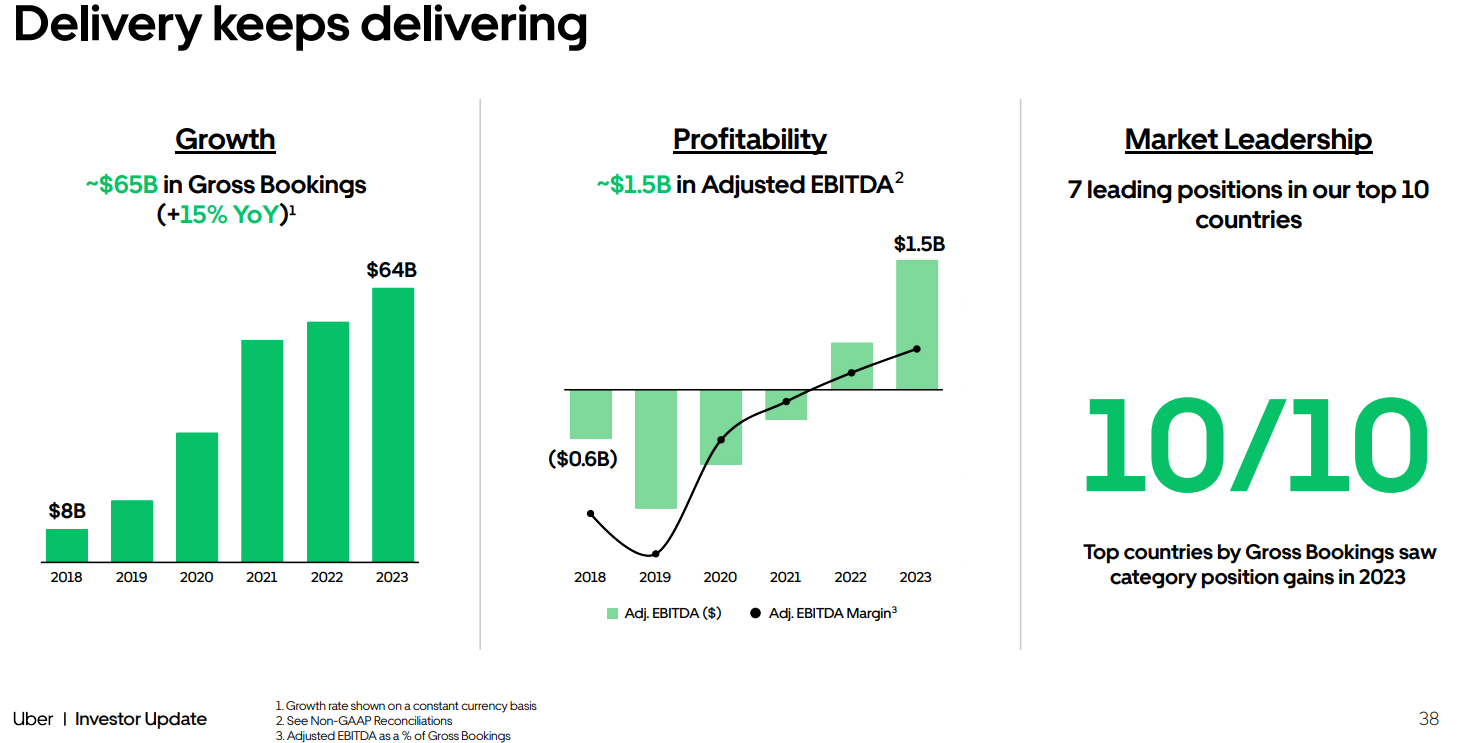
Post-pandemic, we witnessed a boom in delivery. While growth eventually moderated, Uber has continued growing on all fronts. From 2021 to 2023:
More demand: +8% consumers and +11% trips per consumer
More supply: +19% merchants and +29% couriers
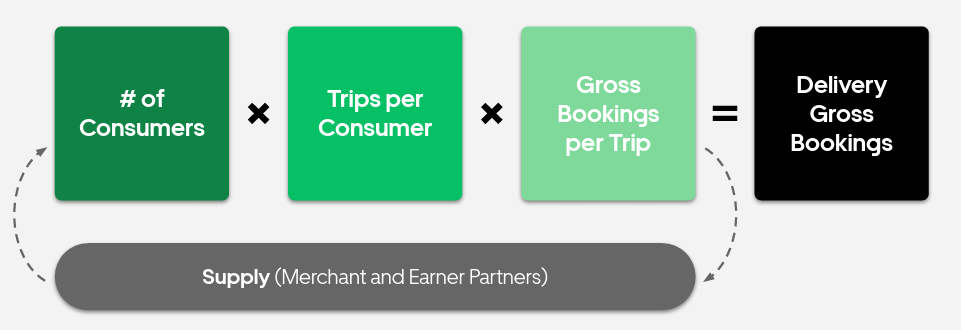
As with mobility, expected growth comes from a combination of increased supply and demand, both benefiting from favorable tailwinds.
Delivery Is Accelerating Its Growth
The platform is expanding every quarter, benefiting from the same virtuous cycle as Mobility. The larger the offering, the more consumers are attracted, and the more consumers attracted, the more merchants join the platform, and so on.
The company is expanding the platform through different value propositions:
Integrate Uber into loyalty programs from top companies like Amex, Delta, and Marriott
Integrate Uber into restaurant and merchant management apps such as Deliverect, Olo, and Square
Improve platform monetization and create additional revenue streams
Strengthen last-mile logistics to become a logistics platform, not just a marketplace
All of this is amplified by the Uber One membership, which now has approximately 36 million users.
Consumer Value
Uber Delivery integrates with loyalty programs, credit cards, airlines, and travel brands such as Delta (2nd largest airline), Amex, Marriott (largest hotel brand in the world), and Revolut. This increases switching costs for both Uber and its partners.
Also, the company focuses on customer experience. As an example, recently the platform made a mistake and a rifer had to collect two different items, my burger and some grocery things for another. My burger came late and cold. I sent a message to Uber and immediately, without talking to anybody, the company issued an immediate refund.
Merchant Enablement
Uber aims to make it easier for restaurants and retailers to operate, grow, and scale on Uber. Uber integrates directly into merchants’ existing tools such as:
Deliverect (connects delivery apps directly to a restaurant point of sale)
Olo (a digital ordering and guest engagement platform used by large restaurant brands such as Shake Shack, Chipotle, and Five Guys)
OpenTable (restaurant management platform owned by Booking Holdings)
Square (a payments ecosystem for small and mid-sized businesses)
Platform Enhancement
Uber is improving monetization, advertising, and payment flexibility. Instead of earning primarily from delivery fees and merchant commissions, Uber is expanding into new high-margin revenue streams such as advertising and sponsored placements.
The company is partnering with:
Criteo, a commerce media platform specializing in performance-based ads that allows merchants to retarget users to increase order frequency and improve unit economics without affecting delivery costs. Criteo acts as a demand amplifier for the platform.
Instacart Ads, one of the most successful retail media networks. The partnership aims to make it easier for consumer packaged goods brands of all sizes to advertise on their platform, not just the largest brands they work with directly.
Klarna, one of the largest Buy Now, Pay Later (BNPL) platforms, enabling customers to split and defer payments on delivery (especially useful for premium or expensive products). This allows Uber to access the BNPL space without assuming the associated credit risk.
Last-Mile Logistics
The last mile is the most challenging and expensive part of delivery. To expand delivery beyond Uber Eats, Uber needs to attract large retailers and enterprises that require higher logistics standards—scheduled delivery, multi-carrier routing, etc.
Uber is partnering with third-party providers to enhance last-mile logistics:
Bringg, a company that acts as a “control tower” for delivery operations and routes orders across Uber, internal fleets, and third-party couriers. The platform is used by large retailers and grocers, and Uber aims to become one carrier among many within Bringg.
Delivery Solutions, a multi-carrier management platform focused on retail and e-commerce that connects retailers with dozens of carriers, enabling same-day, next-day, and scheduled deliveries. By partnering with this platform, Uber can be selected automatically when same-day delivery is needed, local inventory is closest, or Uber offers the cheapest or fastest alternative.
Nash, a last-mile delivery platform built for Shopify and similar platforms. Nash now integrates Uber directly into e-commerce checkout flows.
Instead of building everything in-house, Uber aims to make operations seamless for merchants and restaurants, eliminating all possible barriers. This strategy allows Uber Delivery to constantly expand its platforms and service offerings.
It’s not only about ensuring a great user experience but also making merchants’ and restaurants’ operations significantly easier.
